Introduction
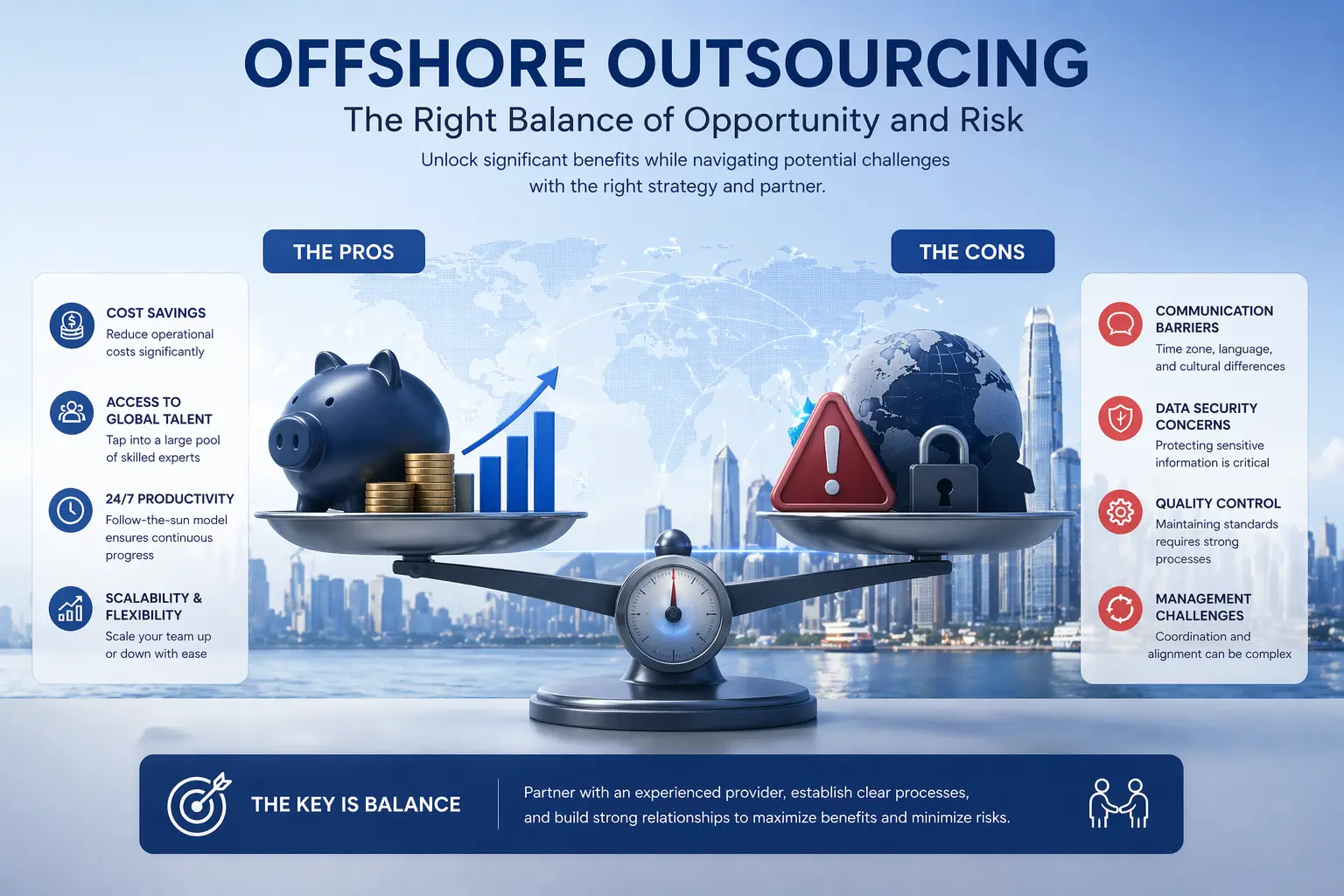
For B2B decision-makers in Hong Kong, Taiwan, Macau, and mainland China, offshore outsourcing remains one of the most debated strategic choices of 2026. On one side, it promises dramatic cost reduction and access to global talent. On the other, it introduces risks around communication, data security, and quality control that can derail entire digital transformation programs.
This guide provides a balanced, data-driven analysis of the real pros and cons of offshore outsourcing — supported by 2026 market data, real-world case studies, and practical frameworks you can apply to your own sourcing decisions.
💡 This article is part of our pillar content series on Outsourcing of Information Technology Services: 2026 Guide For pricing details and vendor-selection frameworks, see our companion guides.
What Is Offshore Outsourcing? (A Quick Refresher)
Offshore outsourcing is the practice of contracting business functions — most commonly IT, software development, customer support, and back-office operations — to service providers located in a distant country, typically across continents or time zones.
Popular offshore destinations for Greater China clients include:
- India — the global leader in IT services outsourcing
- The Philippines — dominant in customer support and BPO
- Vietnam — fast-growing in software development
- Eastern Europe (Poland, Ukraine, Romania) — strong for high-end engineering
Offshore outsourcing differs from nearshore (nearby country, small time-zone gap) and onshore (same country) models. The defining characteristic of offshore is significant geographic and cultural distance, which drives both its biggest advantages and its biggest risks.
The Pros of Offshore Outsourcing
✅ Pro #1: Substantial Cost Reduction
Cost arbitrage remains the most cited advantage of offshore outsourcing — and the numbers are compelling. Offshore outsourcing can reduce operational costs by 50–70% compared to hiring equivalent in-house talent in Hong Kong, Singapore, or Western markets.
Typical 2026 hourly rate comparisons for mid-level software engineers:
| Region | Approx. Hourly Rate (USD) |
|---|---|
| Hong Kong / Singapore | $80 – $150 |
| United States / Western Europe | $100 – $200 |
| Eastern Europe | $40 – $80 |
| India / Philippines | $20 – $50 |
| Vietnam | $20 – $45 |
For a 10-person development team running for 12 months, the savings can exceed USD $1 million annually — savings that can be redirected into product innovation or go-to-market investment.
✅ Pro #2: Access to a Vast Global Talent Pool
Hong Kong and Taiwan both face well-documented IT talent shortages. Over 75% of technology firms in Hong Kong report difficulty filling critical vacancies in cybersecurity, cloud architecture, and data engineering roles.
Offshore outsourcing unlocks access to massive talent markets:
- India produces over 1.5 million STEM graduates annually
- The Philippines has over 1.3 million BPO workers
- Vietnam graduates roughly 57,000 IT engineers per year
This scale makes it feasible to staff specialised roles — AI/ML engineers, DevSecOps specialists, SAP consultants — that may take 6–12 months to recruit locally.
✅ Pro #3: 24/7 “Follow-the-Sun” Operations
The time-zone gap that is often cited as a disadvantage can also be a strategic advantage. With a follow-the-sun model, your Hong Kong team’s end-of-day becomes the offshore team’s start-of-day, enabling around-the-clock progress on critical projects.
Real-world applications:
- A Hong Kong fintech shortens its release cycle from two weeks to one by having Vietnamese developers continue work overnight
- A Taiwanese e-commerce platform provides 24/7 customer support without hiring local night-shift staff
- A Macau hospitality group runs continuous security monitoring across three offshore SOC shifts
✅ Pro #4: Faster Time-to-Market and Scalability
Offshore providers can typically scale a team up or down within 2–6 weeks — far faster than in-house hiring in Greater China, which often takes 3–6 months per specialist role. This elasticity is particularly valuable for:
- Short-term digital transformation projects
- Seasonal product launches
- Rapid prototyping and MVP development
- Crisis-driven initiatives (e.g., sudden regulatory compliance changes)
✅ Pro #5: Focus on Core Business Activities
By offloading commoditised or non-core IT functions (help desk, infrastructure monitoring, routine app maintenance) to offshore providers, in-house teams can focus on higher-value activities — strategic planning, customer experience, and innovation — that directly influence revenue growth.
The Cons of Offshore Outsourcing
⚠️ Con #1: Communication and Time-Zone Challenges
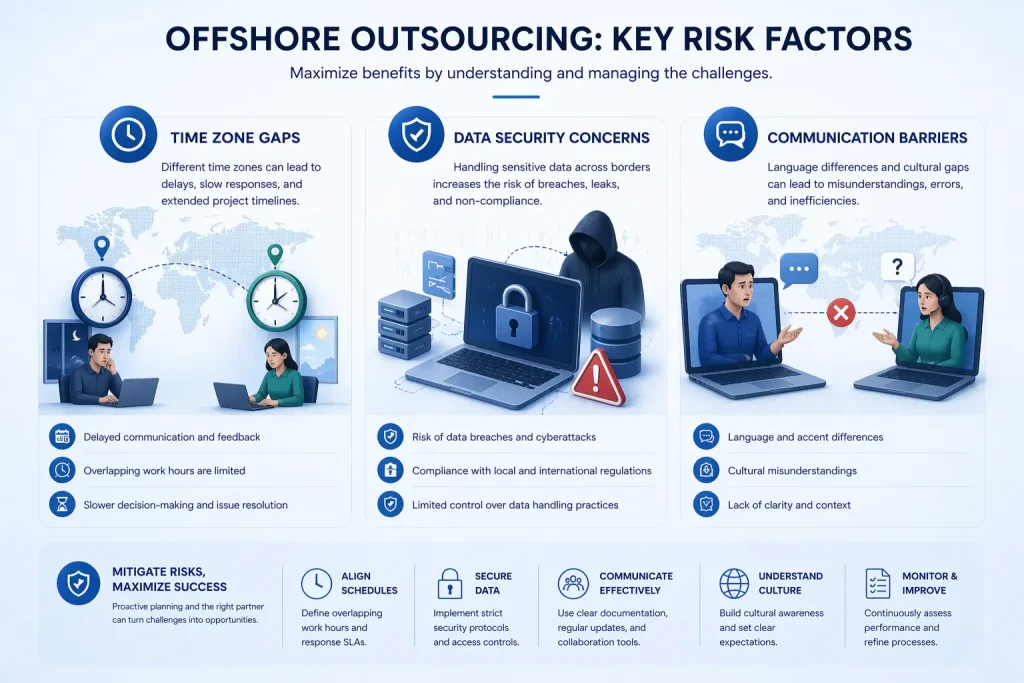
What enables follow-the-sun can also create friction. When your team needs a real-time decision and your offshore partner is sleeping, urgent issues can stall for 8–12 hours. Common communication challenges include:
- Reduced real-time collaboration, especially for agile ceremonies
- Written-communication fatigue from long email/Slack threads
- Escalation delays during production incidents
- Cultural differences in interpreting “urgent” or “done”
Mitigation: Overlap at least 3–4 working hours daily, establish clear escalation SLAs, and invest in asynchronous collaboration tools (Loom, Notion, detailed ticketing).
⚠️ Con #2: Data Security and Compliance Risks
For businesses operating under Hong Kong’s PDPO, mainland China’s PIPL, or Taiwan’s PDPA, offshore data handling is a serious compliance consideration. Sending personal data, financial records, or intellectual property to an offshore provider may trigger:
- Cross-border data transfer restrictions (especially under PIPL in mainland China)
- Audit trail complexity
- Increased risk of breaches from less-mature security postures
- Legal jurisdiction uncertainty in the event of disputes
Mitigation: Require ISO 27001 and SOC 2 certifications, implement data residency clauses, use encrypted VPNs and zero-trust architectures, and maintain an onshore governance layer for regulated data.
⚠️ Con #3: Quality Control and Oversight Gaps
Without direct physical presence, quality issues can take longer to detect. Common problems include:
- Code quality variance across offshore developers
- Incomplete documentation
- “Surface compliance” with SLAs but poor outcomes
- Turnover of key personnel without notification
Mitigation: Implement rigorous code review processes, use automated quality gates (SonarQube, SAST tools), require monthly governance reviews, and always retain a senior architect onshore.
⚠️ Con #4: Cultural and Language Barriers
Even when English proficiency is strong, subtle cultural differences around hierarchy, feedback, and conflict resolution can affect delivery. For example:
- Some cultures strongly avoid saying “no” directly, which can mask project risks
- Feedback styles vary — what feels normal in Hong Kong may feel harsh in Manila
- Decision-making norms differ (consensus vs. top-down)
Mitigation: Invest in cultural awareness training, appoint bilingual project managers as bridges, and foster open feedback channels early in the engagement.
⚠️ Con #5: Hidden Costs That Erode Savings
The headline savings of offshore outsourcing often look larger on paper than in reality. Hidden costs include:
| Hidden Cost Category | Typical Impact on Total |
|---|---|
| Transition & onboarding | 5–15% of annual contract |
| Governance & oversight | 10–20% of contract value |
| Rework due to quality issues | 5–15% |
| Knowledge transfer & documentation | 3–8% |
| Travel & occasional on-site visits | 2–5% |
| Tooling & security infrastructure | 3–7% |
When fully accounted, the real savings often shrink from a headline 60% to an actual 30–40% — still meaningful, but not what many executives initially forecast.
⚠️ Con #6: Intellectual Property and Vendor Lock-In Risks
Offshore engagements can create IP exposure and dependency:
- Source code, algorithms, and proprietary processes leave your direct control
- Some jurisdictions offer weaker IP enforcement
- Over-reliance on one vendor makes switching costly
- Knowledge concentration creates “single-point-of-failure” risk
Mitigation: Draft airtight IP assignment clauses, require code escrow for critical systems, and maintain in-house knowledge of at least the system architecture.
Offshore Outsourcing Pros and Cons: Summary Comparison Table
| Dimension | Pros ✅ | Cons ⚠️ |
|---|---|---|
| Cost | 50–70% headline savings | Hidden costs reduce real savings to 30–40% |
| Talent | Access to millions of specialists | Quality variance; turnover risk |
| Speed | Fast team scaling; follow-the-sun delivery | Time-zone gaps delay urgent decisions |
| Control | Offload non-core work | Reduced oversight and direct visibility |
| Compliance | Global vendors with advanced certifications | Cross-border data transfer complexity |
| Culture | Exposure to diverse perspectives | Language & communication friction |
| Strategy | Focus internal resources on core business | IP exposure; vendor lock-in |
Real-World Case Studies
Case Study 1: Success — Hong Kong Fintech Scales Engineering with Offshore Team
A Hong Kong-based payment technology company needed to scale its engineering team from 15 to 50 within six months — impossible in the local market. By partnering with an offshore provider in Vietnam:
- Team scaled to 48 engineers in 5 months
- Development cost per engineer dropped by 58%
- Product release cycle shortened from monthly to bi-weekly
- Success factors: strong onshore tech lead, dedicated project manager bridge, robust CI/CD
Case Study 2: Cautionary — Taiwanese Retailer’s IP Dispute
A Taiwanese e-commerce retailer outsourced its proprietary recommendation engine to a small offshore vendor to save costs. Twelve months later:
- The vendor’s lead developer left and joined a competitor
- The original contract lacked clear IP assignment clauses
- Legal action across borders took 18 months and significant cost
- Lesson: offshore savings mean nothing without proper IP protection
Case Study 3: Hybrid — Macau Hospitality Group’s Balanced Approach
A Macau-based hospitality group took a hybrid approach: onshore governance in Hong Kong for strategy and compliance, offshore delivery in the Philippines for 24/7 help desk and India for development:
- Achieved 42% total IT cost reduction
- Maintained PDPO compliance through onshore data controllers
- 24/7 guest support with no local night-shift hiring
- Best practice: hybrid models often deliver better risk-adjusted outcomes than pure offshore
When Offshore Outsourcing Makes Sense (And When It Doesn’t)
✅ Good Fit for Offshore
- Large-scale software development with well-defined requirements
- Non-sensitive data processing and back-office operations
- Predictable, repeatable IT support tasks
- 24/7 monitoring and operations
- Companies with mature outsourcing governance capability
❌ Poor Fit for Offshore
- Highly regulated industries (banking, healthcare) with strict data residency
- Early-stage products requiring fast iteration and real-time collaboration
- Functions requiring deep local market and cultural understanding
- Organisations without in-house technical leadership to manage vendors
- Short-term projects under 3 months (onboarding overhead outweighs savings)
Frequently Asked Questions (FAQ)
What is the biggest advantage of offshore outsourcing?
The most commonly cited advantage is cost savings of 50–70% on labour-intensive IT functions. However, in 2026 surveys, many executives now rank access to global talent and faster scaling as equally or more important than pure cost reduction.
What is the biggest risk of offshore outsourcing?
Data security and compliance exposure rank as the top concern for B2B decision-makers in Greater China, especially given PDPO, PIPL, and PDPA regulations. Hidden costs and quality variance follow closely behind.
How much can offshore outsourcing really save me?
The headline savings of 50–70% typically reduce to 30–40% net savings once you account for governance, transition, rework, and tooling overhead. This is still significant but more realistic for budgeting purposes.
Is offshore outsourcing secure for regulated industries?
It can be — but requires careful design. Regulated industries should demand ISO 27001, SOC 2, data residency clauses, and retain onshore data controllers. For highly sensitive workloads (banking core systems, patient medical records), a hybrid model or onshore outsourcing is usually safer.
Offshore vs nearshore outsourcing — which is better?
Offshore typically offers greater cost savings; nearshore offers better time-zone overlap and cultural alignment. For Hong Kong clients, nearshore options like mainland China or Malaysia are often the sweet spot for transformation projects, while offshore excels for large-scale, lower-complexity work.
Can small businesses benefit from offshore outsourcing?
Yes, but with caveats. SMBs often lack the governance bandwidth to manage offshore vendors effectively. A managed services model — where the provider handles governance — is often a better fit than traditional staff augmentation for smaller teams.
How do I protect intellectual property in offshore arrangements?
Four essentials: (1) explicit IP assignment clauses in your contract, (2) code escrow for critical systems, (3) restrictions on subcontracting without approval, and (4) maintaining in-house knowledge of core system architecture to avoid total dependency.
How long does it take to onboard an offshore team?
A typical offshore team reaches full productivity in 6–12 weeks. Pilot engagements can launch in 2–3 weeks. Complex regulated environments may require 3–6 months for full onboarding including security certifications.
Conclusion: Making the Right Offshore Decision in 2026
Offshore outsourcing is neither a silver bullet nor a trap — it is a strategic tool that delivers exceptional value when applied correctly, and serious problems when applied carelessly. The companies that succeed with offshore outsourcing in 2026 share three characteristics:
- They choose offshore for the right work — large-scale, well-defined, non-sensitive functions
- They invest in governance — not just the offshore team, but the onshore management layer that oversees it
- They plan for reversibility — with clear exit clauses, code escrow, and retained in-house knowledge
For most Hong Kong, Taiwan, Macau, and mainland China enterprises, the optimal answer is rarely pure offshore — it’s a hybrid model that combines offshore efficiency with onshore control.
🚀 Ready to Evaluate Offshore Outsourcing for Your Business?
Artek Global is a Hong Kong-headquartered technology partner providing IT Solutions, Development, Marketing, and Design services across Greater China. Our team has helped B2B clients design and govern offshore, nearshore, and hybrid outsourcing arrangements that actually deliver on their business cases.
Book a complimentary 30-minute offshore outsourcing assessment with a senior Artek consultant. You will walk away with:
✅ A risk-adjusted savings estimate for your specific scope
✅ A recommended sourcing model (pure offshore vs hybrid vs nearshore)
✅ A compliance checklist tailored to your industry and regulations
✅ A vendor-evaluation scorecard you can use immediately
👉 Book Your Free Offshore Outsourcing Assessment →
👉 Explore Artek Global’s Hong Kong Managed IT Services →