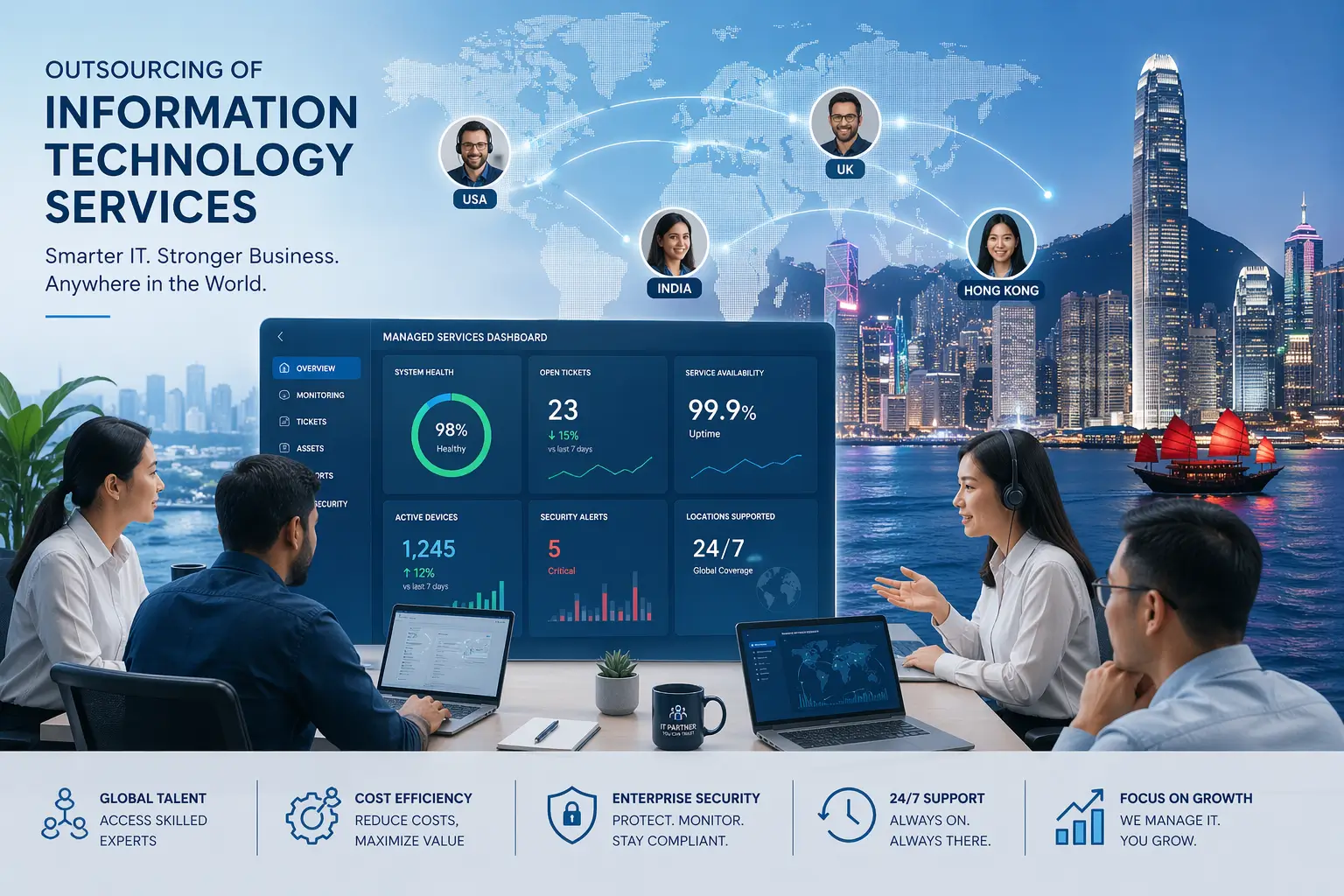
Introduction: Why 2026 Is a Defining Year for IT Outsourcing
For decision-makers in Hong Kong, Taiwan, Macau, and mainland China, outsourcing of information technology services has evolved far beyond a simple cost-reduction tactic. It is now a strategic lever for digital transformation, cybersecurity resilience, and AI adoption.
The numbers confirm this shift. The global IT services outsourcing market is estimated to be valued at USD 462.10 billion in 2026 and is expected to reach USD 861.10 billion by 2033, exhibiting a compound annual growth rate (CAGR) of 9.3% from 2026 to 2033.[9] Meanwhile, 92% of the world’s 2,000 largest companies use IT outsourcing[4] — proving that outsourcing is no longer optional for enterprises operating at scale.
Most strikingly, the reason companies outsource has fundamentally changed. Cost is no longer the primary driver. Only 34% of executives now cite cost reduction as their main reason for outsourcing, down from 70% in 2020. What replaced it? Access to specialized talent, digital transformation capabilities, and AI-augmented service delivery.[4]
This guide — the pillar resource for everything you need to know about outsourcing of information technology services in 2026 — will walk you through the definitions, types, costs, risks, and selection criteria that matter most for B2B decision-makers in Greater China and beyond.
1. What Is IT Outsourcing? (Definition & Scope)
IT outsourcing is the business practice of contracting external third-party vendors to handle information technology functions, rather than managing them entirely with internal staff.
According to industry consensus, IT outsourcing is the practice of engaging third-party service providers to deliver IT-enabled business processes, application services, and infrastructure solutions to achieve business objectives. This approach empowers clients to formulate optimal sourcing strategies, identify suitable IT service providers, structure advantageous contracts, and establish effective governance for enduring and mutually beneficial collaborations with external partners.[8]
1.1 The Three Layers of Modern IT Outsourcing
Today’s IT outsourcing engagements typically span three layers:
- Infrastructure outsourcing — servers, networks, cloud environments, data centres
- Application outsourcing — software development, maintenance, modernisation
- Managed services — end-to-end operational responsibility under defined SLAs
Infrastructure outsourcing involves delegating physical and virtual asset management, including cloud environments and network security, to external providers. This approach helps mitigate capital expenditures on proprietary server farms. The shift to hybrid and multi-cloud architectures requires partners proficient in integrating legacy systems with modern software-defined networking.[2]
1.2 Why Outsourcing Has Become Strategic, Not Tactical
The contemporary view is that the IT outsourcing market is undergoing a significant transformation, moving beyond traditional cost-saving engagements to become a strategic enabler of digital innovation. This evolution is driven by the increasing need for specialized expertise in areas like generative artificial intelligence, cloud-native services, and cybersecurity. As organizations adopt multi-sourcing strategies, they are shifting from monolithic contracts to agile partnerships that leverage niche capabilities.[2]
For Hong Kong enterprises, this matters because it reframes the C-suite conversation from “How much can we save?” to “How fast can we transform?”
2. Types of IT Outsourcing: Offshore, Nearshore, Onshore
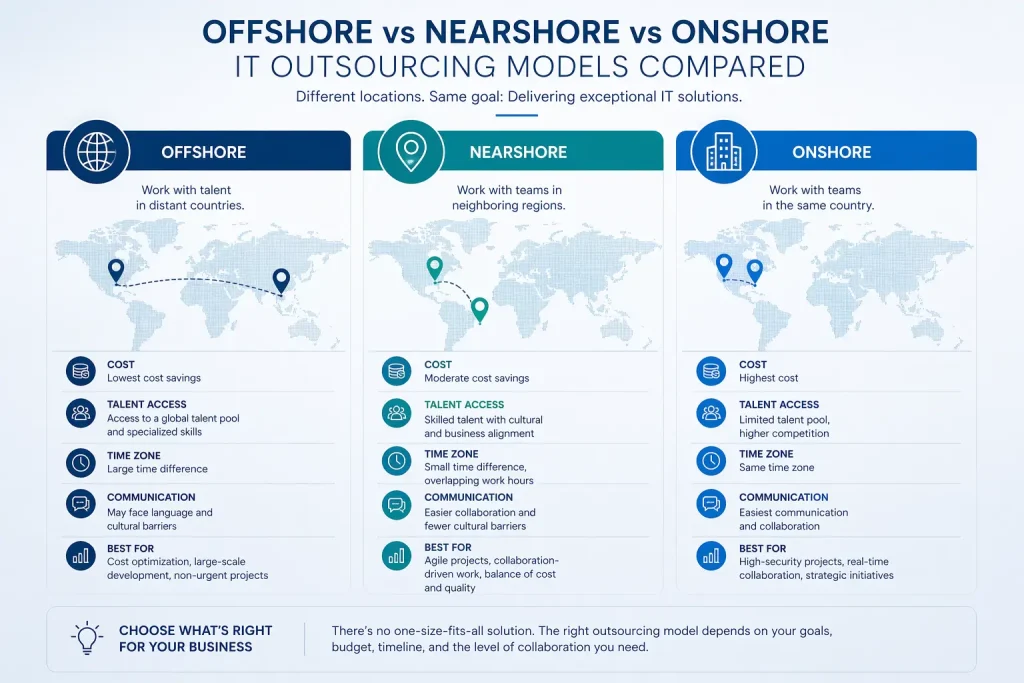
The location of your outsourcing partner defines three primary engagement models. Each has distinct cost, communication, and risk profiles.
2.1 Offshore Outsourcing
Offshore outsourcing means hiring a provider in a distant country — typically for significant cost arbitrage. India, the Philippines, and Vietnam dominate this space. In terms of sourcing model, the offshore outsourcing segment is expected to hold the largest share of the market in 2026, due to cost efficiency, global talent pools, and 24/7 service delivery. Asia-Pacific hubs like India and the Philippines remain preferred destinations. Enterprises leverage offshore providers for application development, cloud management, and cybersecurity, balancing affordability with expertise, while hybrid models supplement collaboration for sensitive or strategic projects.[9]
2.2 Nearshore Outsourcing
Nearshoring means contracting a provider in a nearby country — typically within 1–3 time zones. Nearshoring is prominent in IT, software development, customer support, manufacturing, and shared services. Companies in these sectors leverage the advantages of nearshore outsourcing to streamline operations, access specialized talent, and improve efficiency. As businesses seek to optimize their operations and tap into specialized talent pools, nearshoring stands out as a growing software outsourcing trend in 2026.[8]
For Hong Kong and Taiwan businesses, nearshore options often include mainland China, Malaysia, and Vietnam.
2.3 Onshore Outsourcing
Onshore (or “domestic”) outsourcing means contracting within the same country or city. It is the most expensive model but delivers the strongest communication, legal, and compliance alignment — critical for regulated industries like banking and healthcare.
2.4 Comparison Table: Offshore vs Nearshore vs Onshore
| Evaluation Dimension | Offshore | Nearshore | Onshore |
|---|---|---|---|
| Typical Hourly Rate (USD) | $20–$50 | $40–$80 | $80–$180 |
| Cost Savings vs In-House | 50–70% | 25–45% | 5–20% |
| Time Zone Overlap | 0–4 hours | 4–8 hours | Full overlap |
| Cultural & Language Alignment | Variable | Good | Excellent |
| Data Residency / Compliance Risk | Higher | Moderate | Lowest |
| Best For | Large-scale dev, 24/7 support | Mid-size transformation projects | Regulated industries, BFSI |
| Key Destinations (for HK clients) | India, Philippines, Vietnam | Mainland China, Malaysia | Hong Kong, Singapore |
💡 Artek Global Insight: The right model is rarely “one or the other.” 78% of large organizations are now using Global In-house Centers (GICs) alongside traditional outsourcing to keep core AI intellectual property internal.[7] A hybrid sourcing strategy that combines onshore governance with offshore execution is now the dominant pattern among mature enterprises.
3. Pros and Cons of IT Outsourcing
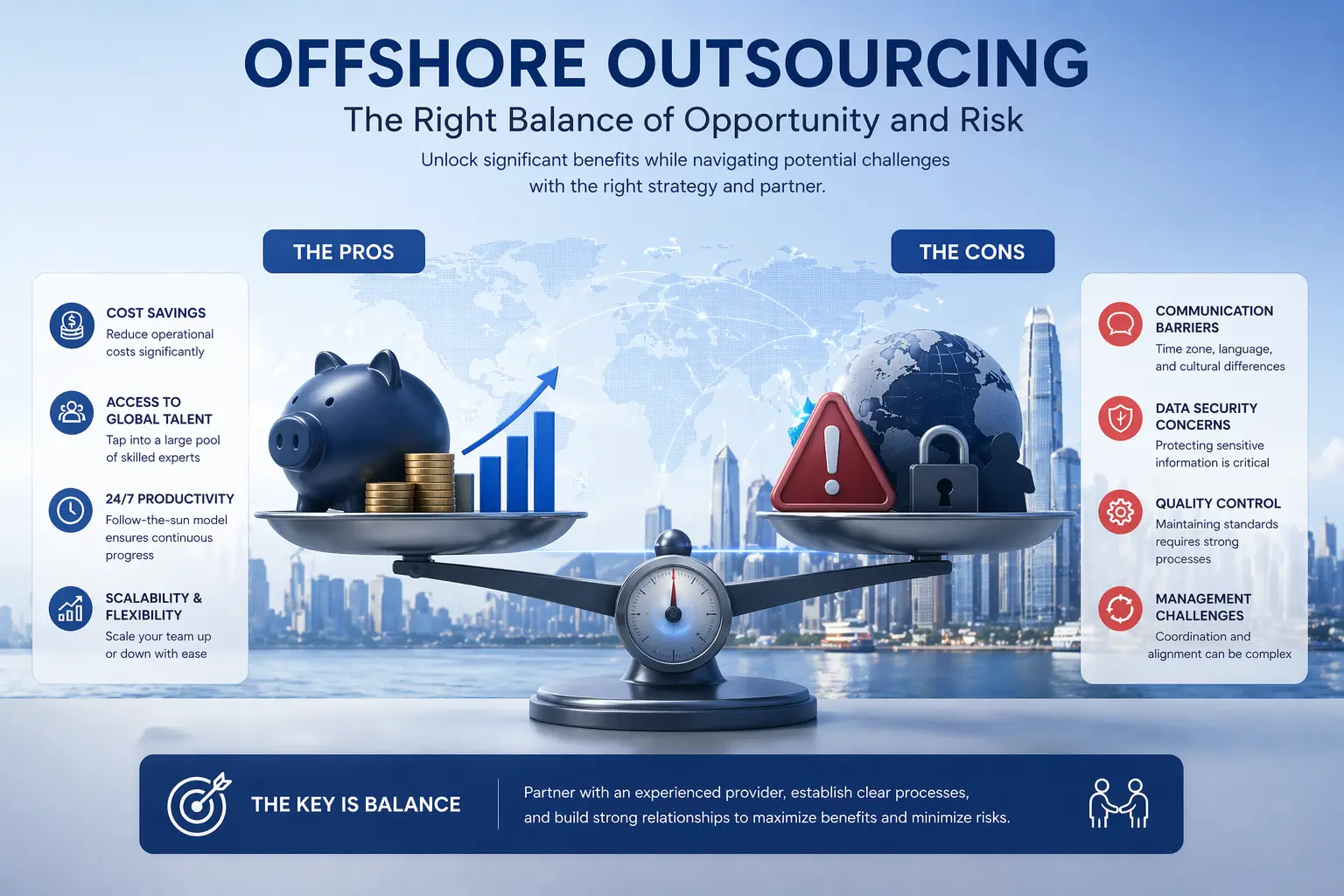
A balanced view of advantages and disadvantages is essential before committing to any outsourcing arrangement. We cover this in depth in our dedicated guide: Offshore Outsourcing: Pros and Cons for 2026 (subpage 1 — deep-dive reading).
3.1 Key Advantages (Summary)
- Access to global talent pools — bypassing local talent shortages, especially acute in Hong Kong where over 75% of technology firms failing to fill critical vacancies in areas like cybersecurity and cloud architecture[5].
- Cost predictability — converting capex (servers, licences, salaries) into opex (monthly service fees).
- 24/7 coverage — through “follow-the-sun” delivery models across multiple geographies.
- Faster time-to-market — Time zone differences, often seen as a challenge, can become an advantage under a “follow-the-sun” model. Asian teams can continue development after Western teams log off, enabling 24-hour progress on critical projects. This operational rhythm accelerates time-to-market for new products and services.[6]
- AI and automation leverage — AI-driven co-pilots are defining a new expectation from outsourced IT services. A GitHub research study involving Microsoft and Harvard found that developers using Copilot completed tasks around 55 percent faster than those who did not.[8]
3.2 Common Risks
- Loss of direct oversight — particularly in fast-changing environments
- Data sovereignty & compliance exposure — critical under GDPR, PIPL, and Hong Kong’s PDPO
- Vendor lock-in — excessive dependency on a single provider
- Cultural and communication gaps — especially in pure offshore models
- Quality variance — without strong SLAs and governance frameworks
👉 Read the full breakdown: Offshore Outsourcing Pros and Cons — Complete Analysis
4. Cost of Outsourced IT Support
Pricing in 2026 has become more sophisticated than the traditional “hourly rate × headcount” calculation. For a full pricing teardown, see our dedicated guide: Outsourced IT Support Costs: A 2026 Pricing Breakdown (subpage 2).
4.1 The Four Dominant Pricing Models
| Pricing Model | How It Works | Best Suited For |
|---|---|---|
| Per-user / Per-device | Fixed monthly fee per endpoint or user | SMBs with stable headcount (HK $300–$1,200/user/month) |
| Tiered Managed Services | Bronze / Silver / Gold packages | Mid-market companies needing scalable support |
| Outcome-based / SLA-linked | Fees tied to performance KPIs | Large enterprises, digital transformation programs |
| Time & Materials (T&M) | Hourly billing for ad-hoc work | Project-based work, specialist consulting |
4.2 Why Managed Services Are Winning
KPMG and related reports highlight a notable change in expectations. Many companies now view managed services and outcome-based delivery models as the primary approach, with over 80% of surveyed leaders believing modern managed services are essential for achieving strategic outcomes such as resilience, trust, and business growth.[4]
The Hong Kong market reflects this global pattern. SaaS adoption trends among Hong Kong SMEs are accelerating, driven by the need for cost-effective enterprise software for supply chain optimization. Companies offering managed IT services for regulatory compliance report a 40% faster audit completion time than firms relying solely on internal teams. This is especially true for those deploying RegTech software for financial compliance.[5]
4.3 Indicative Spend per Employee (2026)
According to Statista benchmarks, in terms of spend per employee, the average is projected to reach US$156.92 in 2025[5] globally for IT outsourcing. Hong Kong sits meaningfully above this average due to higher local wages and more mature enterprise buyers.
👉 Get the full pricing guide: Outsourced IT Support Costs Explained
5. How to Choose an IT Outsourcing Company
Selecting the right partner is the single most important decision in your outsourcing journey. For a full vendor-evaluation framework, see our detailed guide: How to Choose an IT Support Outsourcing Company (subpage 3).
5.1 The 8-Criteria Vendor Evaluation Framework
- Technical certifications (Microsoft, AWS, Google Cloud, ISO 27001)
- Industry vertical experience — especially for BFSI, healthcare, legal
- Regional presence and language support — Cantonese, Mandarin, English
- Security and compliance posture — SOC 2, ISO 27001, local PDPO/PIPL readiness
- SLA clarity and enforceability
- Scalability and flexibility — ability to ramp up/down teams
- Cultural fit and communication rhythms
- Financial stability and references
6. Commonly Outsourced IT Services
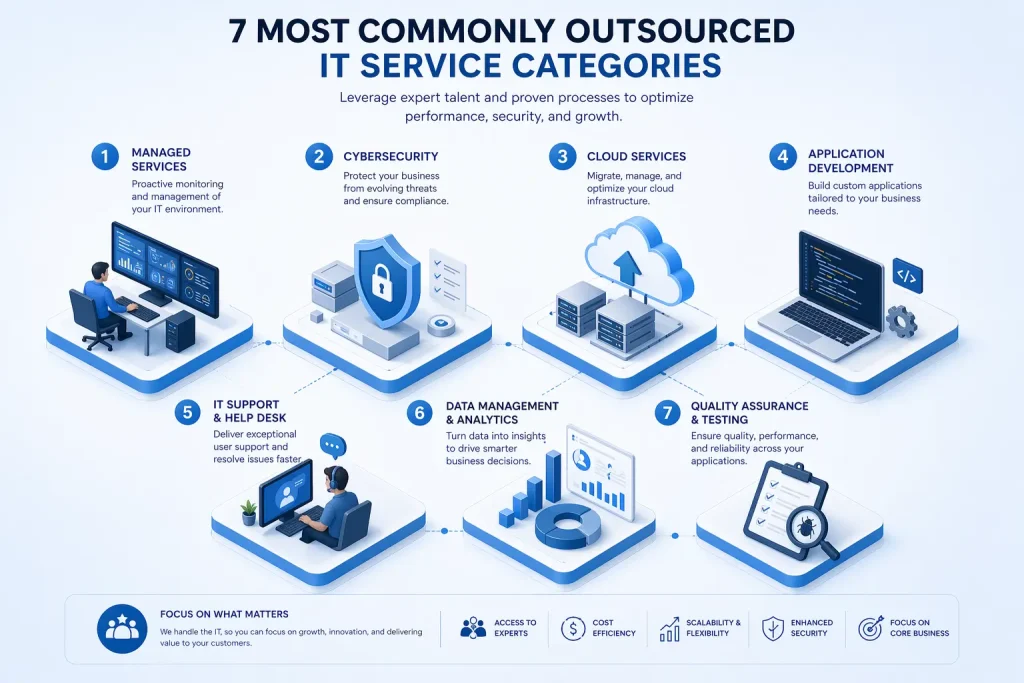
Based on current Hong Kong and global market patterns, these are the most frequently outsourced categories:
6.1 Managed IT Services & Help Desk
Managed IT services in Hong Kong are among the most commonly outsourced solutions. These services include proactive monitoring, infrastructure management, system updates, and ongoing technical support.[3] This is typically the entry point for most companies moving to an outsourced model.
6.2 Cloud Migration & Cloud Management
Cloud services in Hong Kong have become essential for modern businesses. Companies require secure cloud storage, remote collaboration tools, scalable hosting environments, and disaster recovery solutions. IT outsourcing providers help businesses migrate to cloud platforms, manage hybrid infrastructures, and optimize performance.[3]
6.3 Cybersecurity
Cybersecurity services in Hong Kong are critical due to rising digital threats and strict compliance requirements. Financial institutions, e-commerce businesses, and professional services firms must protect sensitive data and maintain regulatory standards. Outsourced IT providers offer firewall management, data encryption, vulnerability assessments, compliance audits, and continuous threat monitoring. Proactive cybersecurity reduces risk and strengthens customer trust.[3]
6.4 Software & Application Development
Many Hong Kong businesses outsource custom software development to build scalable and efficient digital solutions. Software development outsourcing in Hong Kong includes web applications, enterprise systems, CRM platforms, ERP solutions, and mobile applications. Outsourcing development allows companies to access skilled technical teams without the overhead costs of hiring full-time developers.[3]
6.5 IT Consulting & Strategy
IT outsourcing is not limited to technical support. Many companies in Hong Kong require strategic IT consulting to align technology with business goals. Consulting services include technology audits, digital transformation planning, infrastructure upgrades, and cost optimization strategies.[3]
6.6 AI & Generative AI Integration
A rapidly emerging category. Generative AI has recast buying criteria: 87% of North American engineering leaders in 2025 already fund GenAI pilots, and vendors capable of embedding large-language-model toolchains into secure pipelines command premium rates. EPAM projects that 80% of the development life cycle will involve GenAI touchpoints by year-end, potentially raising individual-developer productivity by as much as 75%.[9]
6.7 Data Analytics & Business Intelligence
Including Power BI implementation, data warehouse modernisation, and advanced analytics model deployment.
7. IT Outsourcing in Hong Kong: Regional Context
For businesses headquartered in Hong Kong, the local market has some distinctive dynamics worth understanding.
7.1 Market Size and Growth Trajectory
Hong Kong IT market size is expected to grow by USD 3835.6 million from 2026-2030 expanding at a CAGR of 8.2% during the forecast period.[5] Within this, the IT market in Hong Kong 2026-2030 is increasingly dominated by services, as enterprises pivot from capital-intensive models to operational expenditure frameworks. This shift fuels high demand for IT outsourcing, consulting, and systems integration to manage complex digital transformations.[5]
7.2 Talent Scarcity Drives Outsourcing Demand
The most important structural driver is Hong Kong’s IT talent shortage. A significant talent deficit persists, with over 75% of technology firms failing to fill critical vacancies in areas like cybersecurity and cloud architecture. This gap accelerates reliance on managed service providers for compliance management software and regulatory technology.[5]
7.3 Specialisation Is the New Standard
One of the trends in the IT Outsourcing market in Hong Kong is the shift towards more specialized services. Companies are now looking for vendors that can provide more than just basic IT services but also specialized services such as cybersecurity, data analytics, and cloud migration. This is due to the increasing importance of data privacy and security, which has become a major concern for businesses in Hong Kong.[1]
This is why Artek Global’s Hong Kong Managed IT Services practice focuses on specialised, integrated service bundles — combining IT solutions, development, marketing technology, and design into a single accountable partnership, rather than selling fragmented commodity services.
8. Frequently Asked Questions (FAQ)
What is the difference between IT outsourcing and managed services?
IT outsourcing is the broad category of contracting any IT function to an external provider. Managed services are a specific delivery model within outsourcing where a provider takes continuous, proactive responsibility for defined IT functions (monitoring, maintenance, security) under a fixed monthly fee and clear SLAs. All managed services are outsourcing, but not all outsourcing is managed services.
How much does IT outsourcing typically cost in Hong Kong?
It varies significantly by model. Offshore rates range from USD $20–$50/hour, nearshore from $40–$80/hour, and onshore Hong Kong-based managed services typically HK $300–$1,200 per user per month. See our full Outsourced IT Support Costs guide for detailed benchmarks.
Is IT outsourcing secure?
Security depends entirely on vendor selection and contract design. Mature providers deliver ISO 27001, SOC 2, and industry-specific certifications. Cybersecurity services in Hong Kong are critical due to rising digital threats and strict compliance requirements. Financial institutions, e-commerce businesses, and professional services firms must protect sensitive data and maintain regulatory standards.[3] For regulated industries, we recommend onshore or hybrid models.
How long does it take to onboard an IT outsourcing partner?
A typical enterprise onboarding takes 4–12 weeks, depending on scope. Pilot engagements can launch in as little as 2 weeks. We recommend a structured three-phase approach: assessment (2 weeks) → pilot (30–60 days) → full rollout.
What is the difference between offshoring and outsourcing?
Outsourcing refers to contracting any work to a third party, regardless of location. Offshoring specifically means the work is done in a distant country. You can outsource onshore (local vendor) or offshore (overseas vendor). The two terms are often confused but are not synonymous.
Will AI replace IT outsourcing?
No — it is reshaping outsourcing, not eliminating it. IT outsourcing is undergoing a reset. What was once viewed as a vehicle for infusing offshore cost arbitrage into transactional processes is evolving into a strategic, skills-driven, AI-enabled partnership model.[7] Modern providers embed AI into their delivery to increase productivity rather than compete with it.
What percentage of companies outsource IT?
The adoption rate is now overwhelming at the enterprise level. Consolidated reports indicate that the majority of large corporations (G2000 / Global 2000) rely on outsourcing for at least one IT function, with several sources citing ~90%+ adoption among top enterprises.[4]
Should small and medium businesses outsource IT?
Yes — often with even greater relative benefit than large enterprises. Across small and mid-sized enterprises, accounting and IT services are among the most commonly outsourced functions, as they require specialized skills that may be costly to maintain in-house. According to recent market data, around 37% of small businesses outsource at least part of their business processes. Similarly, about 37% of small and midsize IT organizations expect their spending on IT outsourcing services to increase over the next three years.[4]
What is the biggest mistake companies make when outsourcing IT?
Choosing a vendor on price alone, without evaluating governance, security posture, cultural alignment, and exit clauses. The second most common mistake is failing to maintain sufficient in-house technical literacy to manage the vendor effectively.
Can IT outsourcing be combined with in-house teams?
Absolutely — and this is increasingly the default approach. Instead of completely outsourcing functions, organizations in 2026 want oversight. There are several ways to implement hybrid IT in your company: IT recruitment agencies that fill in-house positions for cybersecurity, AI, and data center expertise; IT service providers who work closely with your in-house team, such as through weekly or monthly strategy meetings; function-oriented solutions that handle specific challenges you face, such as IT help desk services, network maintenance, or data center efficiency management. With this type of customized IT outsourcing, you extract exceptional value out of your investment.[10]
9. Conclusion: Making IT Outsourcing Work for Your Business in 2026
Outsourcing of information technology services is no longer a defensive, cost-driven decision — it is an offensive, growth-driven strategy. The data confirms a clear direction of travel: industry surveys show that ~49.6% of organizations plan to increase their outsourcing levels in the near future, while only around 10% expect to reduce it[4].
For Hong Kong, Taiwan, Macau, and mainland China decision-makers, three principles should guide your 2026 strategy:
- Choose the model that matches your risk profile — onshore for regulated industries, hybrid for most enterprises, offshore for non-sensitive scale work.
- Insist on outcome-based contracts — not hour-counting. Your vendor should be paid for results, not activity.
- Design for reversibility from day one — clear exit clauses, documented runbooks, and knowledge-transfer protocols.
The companies that will win in 2026 are not the ones that outsource the most — they are the ones that outsource the right things to the right partners under the right governance.
🚀 Ready to Build Your IT Outsourcing Strategy?
Artek Global is a Hong Kong-headquartered technology partner providing IT Solutions, Development, Marketing, and Design services to clients across Hong Kong, Taiwan, Macau, and mainland China.
If you are evaluating whether to outsource — or reviewing an existing arrangement — we offer a complimentary 30-minute IT outsourcing strategy consultation with a senior Artek consultant. You will walk away with:
✅ A clear assessment of which outsourcing model (onshore / nearshore / offshore / hybrid) fits your business
✅ Benchmarked cost ranges for your specific service scope and headcount
✅ A risk-and-compliance review tailored to Hong Kong’s PDPO and regional data regulations
✅ Vendor-selection criteria you can use whether you work with Artek or not
👉 Book Your Free IT Outsourcing Consultation →
👉 Explore Our Hong Kong Managed IT Services →
Continue Reading — Pillar Content Series
This guide is the main pillar of our IT outsourcing content series. For deeper exploration of specific topics:
- Subpage 1: Offshore Outsourcing Pros and Cons — A Decision-Maker’s Guide — Comprehensive risk/benefit analysis of offshore models
- Subpage 2: Outsourced IT Support Costs in 2026 — Full Pricing Breakdown — Pricing models, benchmarks, hidden costs
- Subpage 3: How to Choose an IT Support Outsourcing Company — 8-criteria vendor evaluation framework with scorecard template
Learn more:
- IT Outsourcing – Hong Kong | Statista Market Forecast
- IT Outsourcing Market Growth Analysis – Size and Forecast 2026-2030 | Technavio
- 12 Key IT Outsourcing Trends 2026 for Business Growth – Saigon Technology
- What IT Outsourcing Services Are Available for Hong Kong Businesses? – Web & Mobile App Development Company in Hong Kong | KS Softech
- IT Outsourcing Trends in 2026: Key Statistics & Forecasts
- 60+ Outsourcing Statistics for 2026: The Ultimate List
- IT Outsourcing – Worldwide | Statista Market Forecast
- Hong Kong IT Market Growth Analysis – Size and Forecast 2026-2030 | Technavio
- IT Outsourcing to Asia: A Complete Guide 2026 : Aalpha
- 25 Latest Outsourcing Statistics 2026 (US & Global Data)
- 6 Trends Defining the Future of IT Outsourcing
- IT Outsourcing Global Market Report 2026
- IT Outsourcing Trends for 2026 and Beyond
- IT Services Outsourcing Market Size and Forecast, 2026-2033
- Software Development Outsourcing Market Size, Share, Trends 2026 – 2031
- 8 IT Outsourcing Trends To Follow in 2026 | TSP
- Outsourcing Statistics 2026: A Detailed Overview by Invedus